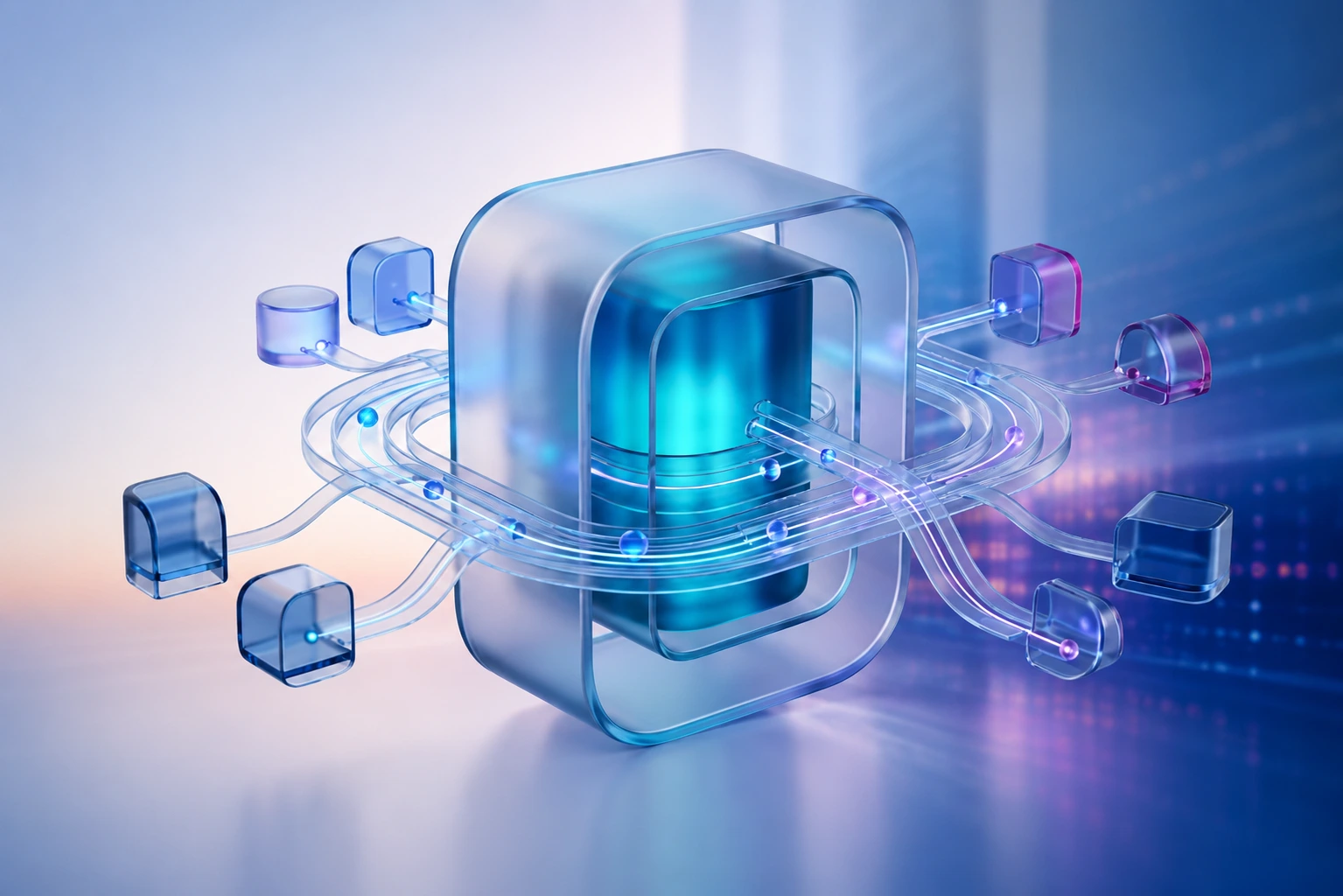
MCP (Model Context Protocol): the complete guide for businesses in 2026
.webp)
Introduction
Since late 2024, one acronym has taken over every technical conversation about enterprise AI: MCP, for Model Context Protocol. Open-sourced by Anthropic in November 2024, this protocol has become, in under two years, the de facto standard for connecting AI agents to enterprise tools and data — since adopted by OpenAI, Google, Microsoft, IBM, and Amazon, and now hosted neutrally by the Linux Foundation's Agentic AI foundation.
For an executive or a CIO, understanding MCP is no longer optional: it's the technical building block that determines whether an AI agent can genuinely act within a company's information system, or stays confined to being a simple conversational assistant. This guide explains what MCP is, why it matters, and what to check before adopting it.
What is MCP? (a simple definition)
The Model Context Protocol is an open standard that defines a single, common way for any AI model to connect to external tools, databases, and applications. The clearest analogy is USB-C: before USB-C, every device had its own connector; USB-C standardized the connection once and for all. MCP does exactly the same thing for AI: instead of building a custom integration between every model and every tool, a single MCP connection is enough to make a tool accessible to any compatible AI agent.
Concretely, MCP relies on three components:
- The MCP server: a connector that exposes a tool's capabilities (CRM, messaging, database, ERP) in a standardized format.
- The MCP client: the application hosting the AI agent, which consumes the capabilities exposed by the available MCP servers.
- The protocol itself: the communication rules between the two, including, since the June 2025 specification, a standardized authentication mechanism (OAuth 2.1).
Why MCP genuinely changes the game for AI agents
Before MCP, connecting an AI agent to ten different business tools required ten custom integrations, each needing individual maintenance with every update. This complexity heavily slowed the deployment of AI agents genuinely connected to a company's information system, outside of a few highly targeted cases built at great expense.
MCP flips this logic: as soon as a tool exposes an MCP server, it becomes accessible to any compatible agent, with no specific development required. This explains the protocol's rapid adoption: enterprise software vendors (CRM, ERP, collaboration tools, databases) are now publishing their own MCP servers, gradually building an ecosystem of ready-to-use connectors rather than an ocean of proprietary integrations.
Concrete enterprise use cases for MCP
Business process automation
An AI agent connected via MCP to a CRM, a messaging tool, and a billing tool can handle a case end to end — qualifying a request, checking information across several systems, generating a response, or triggering an action — without each connection having to be specifically built for that use case.
Search and documentation
MCP servers provide access to internal knowledge bases (wikis, Notion spaces, technical documentation), allowing an agent to answer with the company's real context rather than generic knowledge.
Software development
Coding tools (editors, code management platforms) were among the first to adopt MCP, allowing an AI assistant to read a code repository, check tickets, or propose fixes directly within the development environment.
Multi-agent systems
MCP makes it easier to coordinate several specialized agents that each need access to different tools to accomplish a shared, complex task — an increasingly central building block as agentic AI architectures grow more complex.
Security risks to know before adopting MCP
MCP's rapid adoption comes with risks that not every IT team has anticipated yet. The main points of vigilance identified by the security community:
- The risk of excessive tool exposure. An agent connected to too many MCP servers at once, without granular access control, may end up with broader permissions than necessary.
- "Tool poisoning" attacks. A malicious or compromised MCP server can attempt to manipulate an agent's behavior through the instructions it exposes.
- The need for robust authentication. Since the June 2025 specification, remote MCP servers rely on the OAuth 2.1 standard, with dedicated mechanisms to prevent misuse of access tokens.
- The need for governance and traceability. Knowing precisely which agent accessed which tool, when, and for what action becomes a baseline requirement as soon as an MCP agent touches sensitive data or critical systems.
These aren't reasons to avoid adopting MCP, but points that need to be scoped from the design stage of an AI agent project, not after it goes into production.
MCP vs traditional integrations (API, RPA)
A custom API integration requires a high development effort for each connected tool, which has to be redone for every tool/agent combination. Maintenance falls on each integration individually, with zero interoperability between AI models — every build stays specific to its own use. This is a mature approach, a long-standing standard.
RPA also requires a high development effort, dependent on the target tool's visual interface, with maintenance that's fragile to interface changes. Interoperability between AI models isn't relevant here, since RPA doesn't rely on a language model at all. This is a mature approach as of 2026.
MCP, once the server is available, requires low development effort for each newly connected tool. Maintenance is shared by the MCP server's publisher rather than duplicated by every company, and interoperability between AI models is native: a single MCP server serves every compatible client. This is a fast-growing approach, still being standardized in 2026.
What Qolaig concretely does with MCP
At Qolaig, MCP has become a central building block of our Build methodology: rather than developing a custom integration for every tool in a client's information system (CRM, messaging, ERP, document management tools), we connect our AI agents through existing MCP servers or ones built specifically for the client, which significantly speeds up deployment timelines while keeping a clean, scalable architecture. This approach always comes with a dedicated reflection on access governance: which agent can act on which tool, and with what level of human validation for sensitive actions.
FAQ
Does MCP replace traditional APIs?
No, MCP generally builds on tools' existing APIs, but standardizes how an AI agent discovers and uses them. It's an abstraction layer on top of existing integrations, not a replacement for the underlying technical infrastructure.
Is MCP specific to Claude or Anthropic?
MCP was created by Anthropic, but it's an open standard now adopted by nearly all major AI model providers (OpenAI, Google, Microsoft) and hosted neutrally by the Linux Foundation's Agentic AI foundation.
Should you build your own MCP server or use existing ones?
It depends on the tools already in place: many software vendors now offer their own official MCP server, which avoids the need for custom development. For internal tools or ones very specific to the company, a custom-built MCP server is often still necessary.
Is MCP suitable for an SME/mid-sized company with no dedicated AI technical team?
Yes, provided you get support on the initial scoping: choosing which tools to connect, defining the agent's level of autonomy, and setting up access governance are decisions that don't require deep in-house technical expertise, but do require methodical scoping.
Take action
Connecting an AI agent to your business tools via MCP can significantly speed up an automation project — provided access and governance are properly scoped from the start. At Qolaig, our Workshop → Build → Run methodology builds in this dimension from the very first scoping workshop. Let's talk about your project.

Our latest articles

The 15 AI Agents to Deploy First in Your Company (all industries)

Regional AI Agentic Grants 2026: the complete region-by-region guide